Les Politiques Economiques de Relance Post-Covid-19 : Regards Croisés

June 12, 2020

Le Laboratoire d’Economie Appliquée ( LEA) de la Faculté des Sciences Juridiques Economiques et Sociales Rabat - AGDAL en partenariat avec le Policy Center for the New South, a le plaisir de vous inviter à participer à la table ronde organisée sous le thème «Les politiques économiques de relance Post Covid-19 : Regards croisés », qui se tiendra le vendredi 12 juin 2020 à 18h00 (Heure de Rabat). Les politiques économiques de gestion de la crise issue du covid-19 sont en rupture avec les pratiques antérieures. Elles sont audacieuses et révèlent au grand jour la capacité des pays, quand ils mettent en stand-by les prêts à penser- orthodoxes-, à gérer des chocs extrêmes. Il s’agit maintenant d’examiner la capacité des politiques économiques de relance post Covid-19 à l’échelle internationale et au Maroc, de saisir cet effet de révélation, de le traduire en stratégies innovantes à même de reconstruire un Maroc social inclusif et durable.

Speakers
Abdelaaziz Ait Ali
Head - Research in Economics
Abdelaaziz Ait Ali is a principal Economist and head of the Research Department at the Policy Center for the New South. He joined the Center in 2014 after five years of experience at the Central Bank of Morocco. He worked as an economist in the International Studies and Relations Department and was analyzing the real estate price index and financial asset prices for monetary policy and financial stability purposes. Since then, Abdelaaziz has focused on cyclical and structural issues of the Moroccan economy, including macroeconomic management and industrial policy design. He has published articles on the reform of the exchange rate regime in the Moroccan economy and its implications for macroeconomic regulation, as well as on the evolution of the macroeconomic framework over th ...
Idriss El Abbassi
Professor of economics, Mohammed V University
Idriss El Abbassi is a Professor of Economics at Mohammed V University in Rabat and coordinator of the Master’s programme in economics. He holds a PhD from Florida State University, and his research focuses on open-economy macroeconomics, growth, and structural transformation. He teaches at both the Master’s and PhD levels and is a founding member of the Laboratory of Applied Economics. A former director of the EMPRETEC/UNCTAD programme in Morocco, he has also been a visiting professor in London. He co-authored Human Capital and Economic and Social Development in Morocco and has recently published in The Economic and Labour Relations Review and Structural Change and Economic Dynamics. ...
Lahcen Oulhaj
Laboratoire d'Economie Appliquée (LEA), FSJES Agdal
...
Larabi Jaïdi
Senior Fellow
Larabi Jaïdi is a Senior Fellow at the Policy Center for the New South and an Affiliate Professor at Mohammed VI Polytechnic University. His areas of expertise include international economy, economic policies, international economic relations, regional economies, social development, international relations, and Mediterranean studies. He also served on the Special Commission on the New Development Model of Morocco, a consultative body created in November 2019 to formulate the country's new developmental guidelines. Jaïdi is a former Professor at Mohamed V University in Rabat-Agdal and a founding member of both the Centre Marocain de Conjoncture and the Groupement d’Etudes et de Recherches sur la Méditerranée.   Prof. Jaïdi previously served as Advisor to the Prime Minist ...
Saïd Tounsi
Professor and Researcher, Mohammed V University
Saïd Tounsi is a Professor and Researcher at Mohammed V University in Rabat. A specialistin economic policies, particularly fiscal policy, he has authored several studies onpublic debt sustainability and exchange rate regimes in developing countries. He has alsoco-edited collective volumes on macroeconomic policies in Morocco. A former trainer atthe IGF and Bank Al-Maghrib, he combines academic expertise with institutional experiencein analysing national and international economic dynamics. ...

RELATED CONTENT

  • Authors
    Isabela Carvalho
    April 30, 2025
    The author of this opinion, Isabela Carvalho, is a 2018 alumna of the Atlantic Dialogues Emerging Leaders Program. In today’s interconnected world, knowledge plays a vital role in driving change and shaping solutions. Yet despite the rise of digital tools and global collaboration, persistent gaps in how knowledge is managed and shared continue to limit the Global South’s ability to fully harness its potential. Strengthening resilient knowledge ecosystems fosters inclusive ...
  • April 29, 2025
    At the recent World Bank and IMF Spring Meetings, heightened attention focused on the IMF’s downgraded global economic forecasts. Global growth is now projected at 2.8% for 2025 and 3% for 2026, down from 3.3% in 2024, largely due to rising trade barriers initiated by Mr. Trump’s second...
  • April 28, 2025
    In this episode, we discuss the Economic Report on Africa 2025, focusing on the African Continental Free Trade Area (AfCFTA) and its transformative potential. We explore how North African ...
  • April 23, 2025
    The United States is at a critical juncture, facing a pivotal dilemma: preserving global leadership in a world it no longer fully controls. While it proclaims its primacy in the liberal international order, its actions tell a different story—one marked by tariffs, reshoring policies, and an open attempt to contain China’s rise. This strategy is driven less by long-term vision than domestic political calculus, underscoring the urgent need for strategic recalibration. ...
  • April 17, 2025
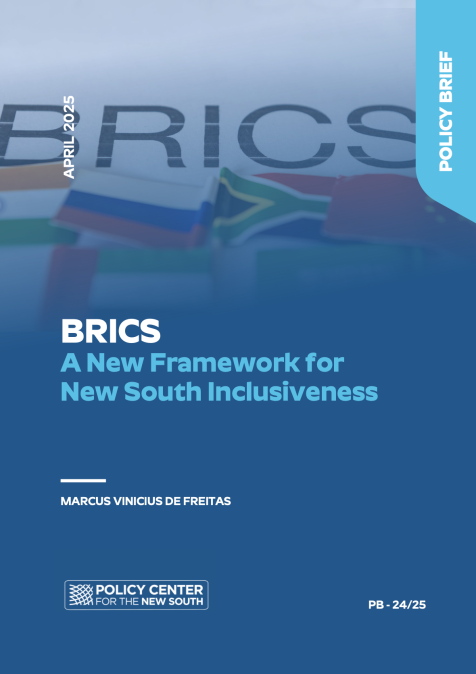
    This policy brief explores the transformative role of BRICS as a platform for Global South cooperation and an emerging alternative to Western-dominated governance frameworks. Established with a shared goal of reforming international institutions and addressing global decision-making imbalances, BRICS has evolved from an economic concept into a multifaceted alliance that spans finance, diplomacy, development, and security. As the global order shifts towards multipolarity, BRICS has p ...
  • Authors
    April 16, 2025
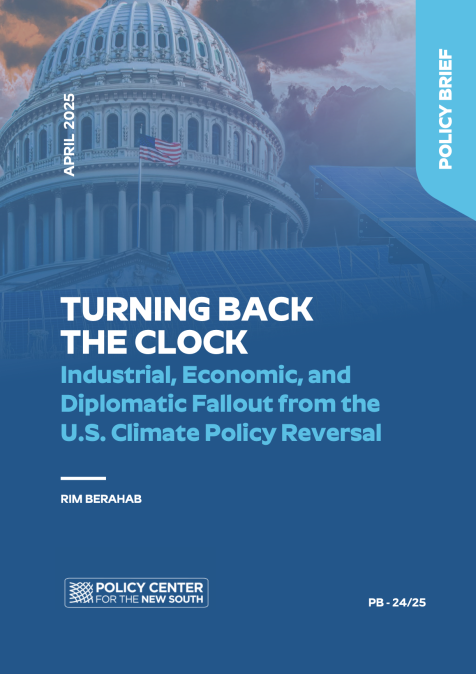
    The second Trump administration’s reversal of federal climate policy is reshaping the U.S. energy and industrial landscape, with significant implications for macroeconomic performance, clean technology competitiveness, and global climate cooperation. While the deregulatory shift and emphasis on fossil-fuel production may generate short-term output gains in selected sectors, the long-term structural transformation necessary for sustained growth in an increasingly low-carbon global ec ...
  • April 11, 2025
    Dans cet épisode, nous décryptons le retour en force du protectionnisme américain, incarné par Donald Trump à l'occasion de son second mandat, à travers sa stratégie "America First". Nous ...