AD Talks 2020: The Age of (Dis)Information

December 10, 2020

The purposeful dissemination of misleading or outright false information by news media and foreign state actors constitutes an increasingly important factor in both the growing erosion of trust in national institutions and political polarization in many countries around the world. The danger that disinformation represents has been clearly demonstrated in the context of the COVID-19 pandemic. The proliferation of conspiracies, misleading narratives and false information about miracle cures have compounded mistrust, uncertainty and even discrimination against nationals of certain countries during the first months of this unprecedented public health crisis. In addition to that, disinformation campaigns and false claims related to the disease and its cures have sparked tangible effects on health of individuals in targeted countries. While the motivations for disinformation campaigns are wide-ranging and include in some cases both the deception of public opinions and promotion of geopolitical goals, the recent events have shown the pressing need for urgent measures and enhanced international cooperation to tackle this issue. Indeed, the far-reaching consequences of the phenomenon have recently pushed states, continental bodies, regional organisations and military alliances to develop strategies to counteract these targeted influence operations. This session will examine these strategies and disinformation’s long term implications on health, security, electoral processes and politics. Definition of disinformation and its present day manifestations: How can we define disinformation? What are the motives behind disinformation campaigns? In what ways does it impact public’s access to information? Strategies to counter disinformation: How can states, multilateral institutions and other stakeholders (journalists) effectively limit public exposure to falsehoods and fabricated information? What strategies can the relevant stakeholders deploy to address structural vulnerabilities in relation to disinformation? Disinformation long term repercussions: To what extent did disinformation contribute to the erosion of trust between citizens and institutions? What are the long term implications of disinformation on human security, electoral processes and politics? Moderator : Blair Glencorse, Executive Director, Accountability Lab; Atlantic Dialogues Emerging Leader (ADEL) Speakers : Pascal Boniface, Director, French Institute for International and Strategic Affairs (IRIS) Bushra Ebadi Youth Ambassador for the Global Alliance for Partnerships on Media and Information Literacy (GAPMIL); Atlantic Dialogues Emerging Leader (ADEL) Andres Schipani, East and Central Africa Correspondent, Financial Times Richard Werly, European Affairs Correspondent, Le Temps

Speakers
Blair Glencorse
Executive Director, Accountability Lab; Atlantic Dialogues Emerging Leader (ADEL)
...
Pascal Boniface
Director, French Institute for International and Strategic Affairs (IRIS)
...
Bushra Ebadi
Youth Ambassador for the Global Alliance for Partnerships on Media and Information Literacy (GAPMIL); Atlantic Dialogues Emerging Leader (ADEL)
She recently worked as a Global Security and Politics Research Associate with the Centre for International Governance Innovation (CIGI), where she provided research and project support to the World Refugee Council in developing solutions to transform the global refugee and internal displacement systems; advanced research on the ethical and social implications of emerging technologies on marginalized populations; and co-developed the Women in Global Governance project, focusing on women in decision-making and leadership in security and politics. Her previous professional experiences include developing refugee housing and integration strategies for arrival cities around the world, supporting humanitarian coordination through her work with the UN Interagency Standing Committee i ...

RELATED CONTENT

  • March 02, 2021
    The Covid-19 pandemic has severely damaged the global economy. Confinement policies, global value chains disruption and risk aversion in the financial systems markets have brought the glo ...
  • Authors
    Paola Maniga
    Yassine Moustanjidi
    February 15, 2021
    The COVID-19 pandemic has exposed new vulnerabilities in social, infrastructure, and governance systems. In the first months of the pandemic, there was a genuine concern about the capacity of the Global South to contain the spread of the virus. African cities were particularly vulnerable, with some experts1, including the head of WHO2, predicting a catastrophe for the continent. Despite the structural and chronic challenges that African cities face, including informality, poverty, a ...
  • Authors
    February 12, 2021
    This paper provides a preliminary assessment of COVID-19’s impact on Africa, focusing on the sub-Saharan Africa (SSA) countries, based on information available as of October 2020. We first identify the two key long-term issues of the SSA countries before the crisis: resource dependency and slow productivity growth. COVID-19 has hit SSA countries hard, causing human and economic destruction and wiping out economic progress from the last decade. Instead of growing at 2.9% in 2020, as ...
  • January 27, 2021
    Fédérateur et vecteur d’inclusion, le sport est mentionné dans l’Agenda 2030 pour le développement durable : il contribue à la paix, à l’autonomisation des femmes et des jeunes ainsi qu’à l’atteinte des Objectifs de développement durable (ODD) en matière de santé, d’éducation et de cohé...
  • Authors
    Sous la direction de
    December 29, 2020
    Dès les premiers cas du Coronavirus relevés en Afrique, les prédictions les plus sombres ont été faites sur la catastrophe sanitaire à venir sur le continent, en raison d’un certain nombre de caractéristiques supposées favoriser la propagation de l’épidémie. Ces prévisions ont été démenties par la rapidité des ripostes des Etats et par divers autres facteurs. La progression de la Covid-19 en Afrique n’est pas le fait d’une dynamique unique mais plutôt de multiples profils de risques ...
  • Authors
    December 14, 2020
    L’économie marocaine fait face à une année 2020 extrêmement difficile et complexe. La crise provoquée par le choc de la Covid-19 est singulière, multicanale et fondamentalement différente des crises précédentes. Elle altère le système productif par un double choc d’offre et de demande, amplifié, de passage, par une crise de confiance. Alors que l’année 2020 touche à sa fin, il est crucial de dresser une première évaluation circonstanciée des ramifications de cette crise, qui permett ...
  • Authors
    Fernando S. Perobelli
    Inácio F. Araújo
    Karina S. S. Bugarin
    December 14, 2020
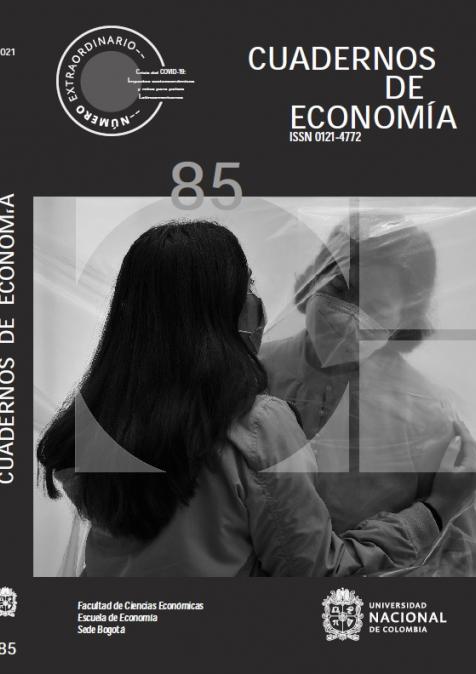
    This paper explores the use of simulations in policy decision-making in the Brazilian State of São Paulo in fighting the COVID-19 pandemic. We propose a methodology for assessing the daily economic costs of control strategies for mitigating the effects of coronavirus. The method is based on the partial hypothetical extraction approach to input–output systems. Simulated daily scenarios based on different levels of compliance to the control measures are used to help guide the design o ...
  • December 10, 2020
    The purposeful dissemination of misleading or outright false information by news media and foreign state actors constitutes an increasingly important factor in both the growing erosion of trust in national institutions and political polarization in many countries around the world. The d...
  • Authors
    Jaime Bonet-Morón
    Diana Ricciulli-Marín
    Gerson Javier Pérez-Valbuena
    Luis Armando Galvis-Aponte
    Inácio F. Araújo
    Fernando S. Perobelli
    July 29, 2020
    The aim of this paper is to assess the regional economic impact of the lockdown measures ordered by the national government to prevent the spread of COVID-19. Using an input–output model, we estimate the economic loss of extracting groups of formal and informal workers from different economic sectors. Results show monthly economic losses that represent between 0.5% and 6.1% of national GDP, depending on the scenario considered. Accommodation and food services, real estate, administr ...