Publications /
Policy Brief

Back
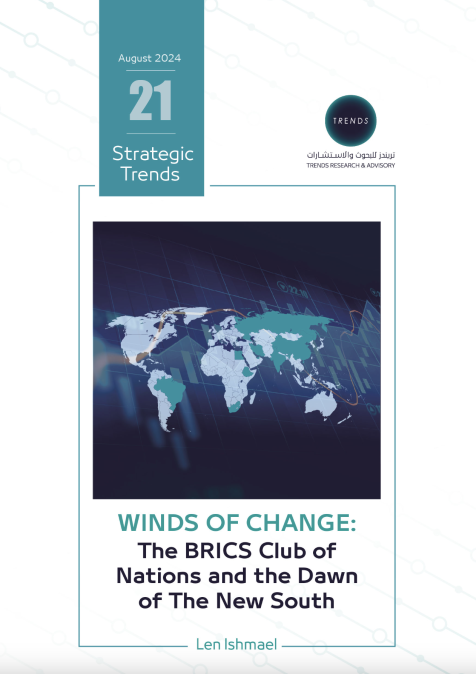
WINDS OF CHANGE: The BRICS Club of Nations and the Dawn of The New South
Authors
November 4, 2024

This paper was originaly published on trendsresearch.org


In this era of polycrises, where a global health pandemic coincides with wars in Europe and the Middle East, alongside Great Power rivalries and climate emergencies, countries around the world—rich and poor alike— are feeling the profound impacts. The Global South,1 in particular, has been disproportionately affected, with the World Bank warning of a ‘decade of lost development.’ As geopolitical tensions rise, security concerns are reshaping the nature of economic relationships between nations. This shift is especially evident in the complex interactions surrounding new technologies and the raw materials they depend on.

The traditional Western-led liberal world order, founded on principles of competition, open markets, free trade, and comparative advantage, is increasingly being challenged by protectionist behaviors in Western markets. The recent focus on de-risking and friend-shoring, justified by both security and economic concerns, has led to the adoption of anti-competitive practices. While the need for economic resilience is widely acknowledged, some argue that these measures are designed to undermine China’s comparative advantage in certain strategic sectors, thereby impeding its challenge to the hegemonic status of the United States and Western power more broadly. Regardless of the rationale, these new policies are adding another layer of disruption to global supply chains, already strained by recent crises. This trend raises concerns about the future of global trade as a critical tool for development, which has historically lifted millions out of poverty.

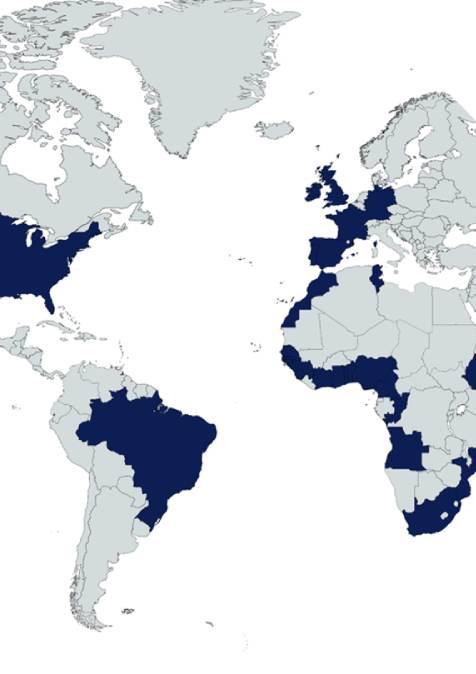
The specter of twelve rounds of Western sanctions on Russia as a consequence of the latter’s war in Ukraine since February 2022, and most recently, G7 initiatives to bankroll Ukraine’s war efforts through funds derived from interests on frozen Russian assets, has led several countries -spearheaded by BRICS members - to consider alternatives to the Western financial institutional architecture in a bid to safeguard their own interests. These measures risk fragmenting the existing global financial infrastructure and derailing benefits derived from decades of economic integration in the face of new barriers to cross border investment, commerce, and trade. Recent research shows that trade restrictions have more than tripled since 2019, financial sanctions have expanded and the geopolitical risk index has also spiked, following Russia’s invasion of Ukraine.2 While this and other reports suggest an absence of clear signs of de-globalization, the point is nonetheless being made that below-the-surface trends speak to increasing fragmentation with “trade and investment flows being redirected along geopolitical lines.”3 After decades of accepting the West’s rules, there is a sense that the era of the Global South is dawning, and that Western interests are no longer de facto those of the rest of the world. It is in this milieu that the BRICS and their initiatives take on heightened economic and political significance.

  • Authors
    December 9, 2022
    The global wave of democratic retrenchment has not spared North Africa as seen in the cases of Tunisia and Sudan, where democratic transitions have stalled or regressed into autocracy. How do to explain Tunisia and Sudan’s troubled transitions from authoritarian rule? Both states are attempting to transition from single-party authoritarianism. In both cases, economic crises exacerbated by COVID, the Russian-Ukraine war, and involvement by external actors stymied the fragile transiti ...
  • Authors
    Amr Abdelrahim
    December 9, 2022
    Depuis quelques années, l’activisme accru de la politique étrangère égyptienne – dans son voisinage africain, méditerranéen et moyen- oriental – donne l’impression du retour d’une puissance régionale dont l’influence s’est pourtant essoufflée à la fin des années 1960. L’avènement du président Abdel Fattah Al-Sissi marque une rupture avec la « diplomatie réactive » de l’ère Moubarak. Cependant, le pays ne dispose simplement plus de ressources militaires, économiques et ...
  • November 24, 2022
    This chapter was originally published in the book "Africa–Europe Cooperation and Digital Transformation", co-edited by Chux Daniels, Benedikt Erfoth, and Chloe Teevan Since the mid-2010s, North African countries have been pursuing what some observers have called a “return to Africa” (Dworkin, 2020). Egypt, Morocco, and Tunisia have attempted to position themselves as major components of Europe- Mediterranean-Africa infrastructure and supply chains corridors (Tanchum, 2020). The thr ...
  • November 15, 2022
    يتزامن هذا اليوم، 15 نونبر 2022، مع تجاوز عتبة 8 مليارات نسمة، ويمكن أن يصل هذا العدد إلى 10 مليارات في عام 2050. ومع ذلك، فإن النمو السكاني يتباطأ من عام إلى آخر على المستوى الدولي على الرغم من أن نسب الخصوبة والولادات متباينة بحسب المناطق. في هذا الإطار، قامت بعض البلدان، بمرور الوقت ...
  • Authors
    November 4, 2022
    This year, the Conference of the Parties (COP27) will be held in in Sharm el-Sheikh, Egypt. On the outset of this auspicious occasion, it is befitting to reflect upon contemporary climate adaptation and mitigation policies, from a southern and African point of view. Indeed, climate change is one of the stickiest policy problems of the 21st century, because it is inherently a global and multidimensional problem entailing a bundle of policy features. Following the consecutives shocks ...
  • Authors
    Sous la direction de
    November 1, 2022
    Dans cette nouvelle édition du Rapport annuel sur la géopolitique de l’Afrique, et à l’instar des éditions précédentes, le maître-mot est la richesse dans la diversité. Une diversité dans les visions et les opinions que des auteurs africains, habitués de cette tribune où qui la découvrent, alimentent en exprimant leurs réflexions sur des questions clés qui intéressent leur continent : l’Afrique. Du cadre social, à celui militaire en passant par les contextes historiques, anthropolo ...
  • October 27, 2022
    Depuis 2016, le Policy Center for the New South et le Centre de Géopolitique de l’école HEC Paris organisent chaque année deux éditions des « Dialogues Stratégiques ». Cette plateforme d’analyse et d’échange réunit des experts, des chercheurs provenant de différents think-tank...