Publications /
Policy Brief

Back
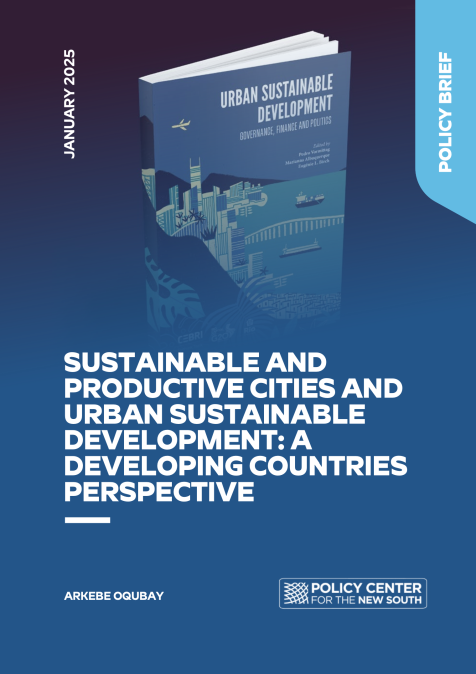
Sustainable and Productive Cities and Urban Sustainable Development: A Developing Countries Perspective
Authors
Arkebe Oqubay
January 20, 2025

This paper, included in the report "Urban Sustainable Development: Governance, Finance and Politics.", was originally published on:https://cebri.org/en/doc/356/cebri-and-rio-g20-committee-publish-urban-sustainable-development-governance-finance-and-politics

 © Vormittag, Pedro, Marianna Albuquerque & Eugénie Birch (Eds.). 2024. Urban Sustainable Development: Governance, Finance and Politics. Rio de Janeiro: CEBRI.


The article discusses the role of sustainable and productive cities as drivers of global transformation. Cities, as the heart of human civilizations, not only propel economic development and serve as technological and innovation hubs but also inspire hope and optimism for the future. They contribute over 80 percent of the global economy and nearly 100 percent to all scientific and technological breakthroughs. Rapid urbanization has been a primary force in the demographic shift that impacts global transformation. With their unparalleled resilience and innovation ability, cities are also at the forefront of significant global challenges, such as the COVID-19 pandemic and climate change, finding sustainable solutions. Cities are not just essential to the 2030 Agenda for Sustainable Development and the Paris Climate Agreement, endorsed by all United Nations member countries, but are the subject and primary actors in implementing it. By recognizing the importance of making “cities and human settlements inclusive, safe, resilient and sustainable” (Goal 11), the 2030 Agenda underscores the importance and impact of cities in shaping the future.

However, in shaping global transformation, cities face significant challenges in releasing their full potential, including financial, governance, and political constraints. A G20 Summit in Rio de Janeiro led by Brasil could be instrumental in promoting city transformation and urban sustainable development as essential components of the development agenda, empowering cities to take charge of their transformation. The objectives of the paper are: (1) to present urbanization and urban transformation as a framework; (2) to explain why and how cities should strive to be not only productive but also sustainable to promote their national development strategies, to achieve Sustainable Development Goals (SDGs) and the net zero agenda; (3) to further discuss the dynamics of city transformation with a focus on Addis Ababa’s transformation as a case study; and (4) to learn from city leadership experiences. The article will explore critical questions: What specific strategies can cities implement to become productive and sustainable cities? What examples of successful city transformation and leadership experiences can be learned from? Given the urbanization wave, population growth, and the lagging structural transformation, these questions have significant implications for cities in emerging and developing economies or the Global South.

This article is enriched by the author’s over three decades of experience in development policymaking and transformation, including serving as the former mayor of Addis Ababa and former minister of urban development. This unique perspective, combined with extensive scholarly and research work drawing from development economics, urban development, and international political economy, provides a comprehensive understanding of the issues at hand. The paper is structured into four sections covering the above mentioned themes, supplemented by an introduction and conclusion. The author’s unique perspective is a critical element that makes this paper a valuable resource for understanding urban transformation.


RELATED CONTENT

  • Authors
    Laurence Nardon
    Mathilde Velliet
    November 23, 2020
    En 2016, l’une des grandes promesses de campagne du candidat républicain Donald Trump était de mettre fin aux pratiques commerciales chinoises, jugées déloyales et responsables du déficit commercial américain. L’imposition d’importants droits de douane allait forcer le gouvernement chinois à négocier. Les pratiques dénoncées par Trump – sous-évaluation du yuan, transferts forcés de technologie, violations de la propriété intellectuelle, manque d’ouverture aux importations – s’inscr ...
  • Authors
    November 19, 2020
     “This time was different” in terms of the monetary policy responses to capital outflow shocks felt by emerging market economies (EMEs), as pointed out by a November 12 Bank for International Settlements bulletin. The pandemic-related global financial shock that hit in March and April led to close to $100 billion leaving EMEs (see my previous article). This was answered by local monetary authorities in ways different from previous episodes. This time there was e ...
  • November 16, 2020
    Africa is experiencing economic growth deceleration that reached 2.9% on average between 2010 and 2018, against 5.4% between 2000 and 2010. The sectoral performance of African economies depends critically on the stock and quality of infrastructure, directly as an essential input (for example, energy and transport) and indirectly by increasing total factor productivity. African economic integration, and the hoped-for emergence, can never be fully achieved with poor infrastructure, bo ...
  • Authors
    Sergio Gusmão Suchodolski
    Cinthia Helena de Oliveira Bechelaine
    Adauto Modesto Junior
    November 13, 2020
    The effective implementation of the 2030 Agenda requires a greater level of capital mobilization and new institutional arrangements that guarantee the better allocation of these funds. Based on concrete results from the experience of the Development Bank of Minas Gerais, in Brazil, this paper argues that Subnational Development Banks (SDBs) can be powerful players within development finance institutions’ networks, as their local expertise can bring efficiency and effectiveness to th ...
  • November 13, 2020
    Avec la venue de Renault à Melloussa, près de Tanger, puis de PSA à Kenitra et, demain, du Chinois BYD, à Casablanca, la filière automobile marocaine aura atteint une capacité annuelle de production de 700 000 à 1000 000 de véhicules, sous différentes marques. Ce qui fait que le Maroc est aujourd’hui le leader des modèles de Tourisme en Afrique. Cette étude rappelle les grandes étapes de cette marche de la maturité et de l'excellence, qui commence en 1959, avec la Somaca (la Société ...
  • Authors
    Raphaël Chiappini
    November 13, 2020
    This article analyzes the impact of firms' workforce composition on cultural distance and export performance. On the one hand, empirical literature has shown that there are dark trade costs that hinder trade performance, among which is cultural distance; on the other hand, the literature has shown that firms' export performance is positively correlated with employees’ qualifications. Using a unique database of 59,606 French firms, we reconcile these two streams of literature by esti ...
  • Authors
    Inácio F. Araújo
    October 27, 2020
    We estimate the contents of services value-added incorporated in goods exports in different countries in Latin America, exploring the local dimension of the results. We use inter-regional input-output analysis to trace and map domestic value-added embedded in those countries’ exports. We add to the discussion of global value chains the internal, withincountry geography of trade in value-added, since the set of locational preferences that help understanding the spatial patterns of na ...
  • Authors
    October 23, 2020
    We have previously discussed how, between March 2020, when the financial shock caused by COVID-19 occurred, and the end of August, the stock and corporate debt markets in the United States performed extraordinarily, despite gloomy prospects on the real side of the economy. The decline in technology stock prices in September ended up taking the equivalent of a month from gains starting in April, but prices remain high. On the basis of such a ‘disconnect from reality’ in fi ...
  • October 22, 2020
    To commemorate the 75th anniversary of the United Nations, the Policy Center for the New South is pleased to organize a series of webinars to discuss key themes related to the role of the UN on the international scene. Moderator : Eduardo Amaral Haddad, Senior Fellow, Policy Center for ...
  • Authors
    Hugo Le picard
    October 22, 2020
    L’enjeu du développement des systèmes électriques centralisés est une priorité pour le développement économique et social de l’Afrique subsaharienne. Alors que la population subsaharienne devrait presque doubler en trente ans selon l’Organisation des Nations unies (ONU), pour atteindre 2,1milliards d’habitants en 2050, dont 1,2milliard d’urbains, le continent va devoir fournir des emplois aux jeunes qui arrivent chaque année plus nombreux sur le marché du travail. Ce sont ainsi 20mi ...