Publications /
Policy Paper

Back
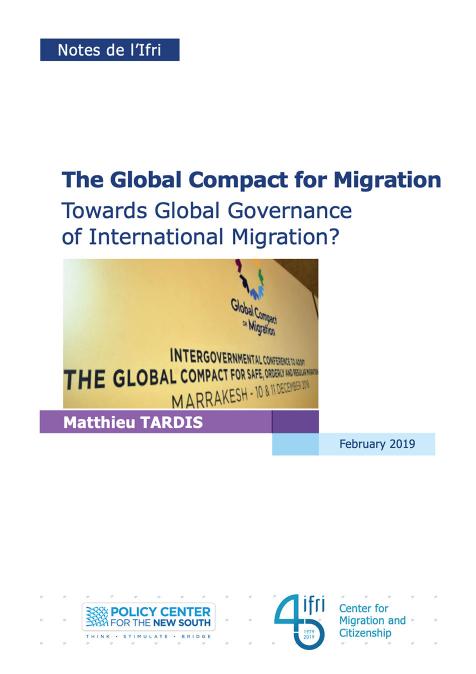
The Global Compact for Migration. Towards Global Governance of International Migration ?
Authors
Matthieu Tardis
February 8, 2019

The “Global Compact for Safe, Orderly and Regular Migration” was adopted in Marrakesh on 10 and 11 December 2018, after 18 months of consultation and negotiation. It is presented as the first United Nations’ agreement on a comprehensive approach to international migration in all its aspects. Although it aims to become the cornerstone of global governance of international migration, sought by the international community, it is however coming up against contradicting national priorities. They are depending on each State’s migration issues; at the mercy of opposition between North and South, the countries of origin and countries of destination.

Furthermore, the Compact illustrates a change in the objectives of global governance of migration, which were originally placed in the post-War context, under the human rights label. At the beginning of the 1990s and the end of communist regimes, migration was perceived as a risk for the stability and security of States. The United Nations then renewed its approach by rather emphasising the positive contribution of migration as a development factor. By highlighting the costs and benefits of migration flows, this approach can reconcile border control policies and the fight against irregular immigration in Northern countries. 

The instruments of global governance of migration illustrate this change. The rights-based approach resulted in the 1990 International Convention on the Protection of the Rights of All Migrant Workers and Members of Their Families. This approach was limited by the refusal of Northern countries to ratify it. Nearly 30 years later, the Global Compact for Migration is pursuing a more pragmatic approach. The agreement is non-legally binding. It reflects a preference for soft law instruments that are able to respond to issues in a more targeted and flexible manner. 

The challenge of the Compact goes beyond mere migration issues and affects the role of the United Nations’ (UN) against a background of questioning multilateralism. The managerial approach to migration promoted by the Compact allows the UN to play a technical support role to States on a voluntary basis. This also leads to a development of different agencies, giving a key role to the International Organisation for Migration (IOM). 
  • Authors
    Amr Abdelrahim
    December 9, 2022
    Depuis quelques années, l’activisme accru de la politique étrangère égyptienne – dans son voisinage africain, méditerranéen et moyen- oriental – donne l’impression du retour d’une puissance régionale dont l’influence s’est pourtant essoufflée à la fin des années 1960. L’avènement du président Abdel Fattah Al-Sissi marque une rupture avec la « diplomatie réactive » de l’ère Moubarak. Cependant, le pays ne dispose simplement plus de ressources militaires, économiques et ...
  • November 24, 2022
    This chapter was originally published in the book "Africa–Europe Cooperation and Digital Transformation", co-edited by Chux Daniels, Benedikt Erfoth, and Chloe Teevan Since the mid-2010s, North African countries have been pursuing what some observers have called a “return to Africa” (Dworkin, 2020). Egypt, Morocco, and Tunisia have attempted to position themselves as major components of Europe- Mediterranean-Africa infrastructure and supply chains corridors (Tanchum, 2020). The thr ...
  • November 15, 2022
    يتزامن هذا اليوم، 15 نونبر 2022، مع تجاوز عتبة 8 مليارات نسمة، ويمكن أن يصل هذا العدد إلى 10 مليارات في عام 2050. ومع ذلك، فإن النمو السكاني يتباطأ من عام إلى آخر على المستوى الدولي على الرغم من أن نسب الخصوبة والولادات متباينة بحسب المناطق. في هذا الإطار، قامت بعض البلدان، بمرور الوقت ...
  • Authors
    November 4, 2022
    This year, the Conference of the Parties (COP27) will be held in in Sharm el-Sheikh, Egypt. On the outset of this auspicious occasion, it is befitting to reflect upon contemporary climate adaptation and mitigation policies, from a southern and African point of view. Indeed, climate change is one of the stickiest policy problems of the 21st century, because it is inherently a global and multidimensional problem entailing a bundle of policy features. Following the consecutives shocks ...
  • Authors
    Sous la direction de
    November 1, 2022
    Dans cette nouvelle édition du Rapport annuel sur la géopolitique de l’Afrique, et à l’instar des éditions précédentes, le maître-mot est la richesse dans la diversité. Une diversité dans les visions et les opinions que des auteurs africains, habitués de cette tribune où qui la découvrent, alimentent en exprimant leurs réflexions sur des questions clés qui intéressent leur continent : l’Afrique. Du cadre social, à celui militaire en passant par les contextes historiques, anthropolo ...
  • October 27, 2022
    Depuis 2016, le Policy Center for the New South et le Centre de Géopolitique de l’école HEC Paris organisent chaque année deux éditions des « Dialogues Stratégiques ». Cette plateforme d’analyse et d’échange réunit des experts, des chercheurs provenant de différents think-tank...
  • Authors
    October 26, 2022
    La Communauté économique des États d’Afrique centrale (CEEAC) a entamé, à partir de 2015, un important processus de réforme institutionnelle. Décidée à l’issue de la XVIème Conférence des chefs d’État et de gouvernement de le CEEAC, tenue à N’Djamena, au Tchad, cette réforme constitue un tournant majeur dans l’histoire de l’organisation et une affirmation de sa centralité dans le processus d’intégration régionale en Afrique centrale. Ce Policy Brief vise à présenter les principaux r ...