Publications /
Policy Brief

Back
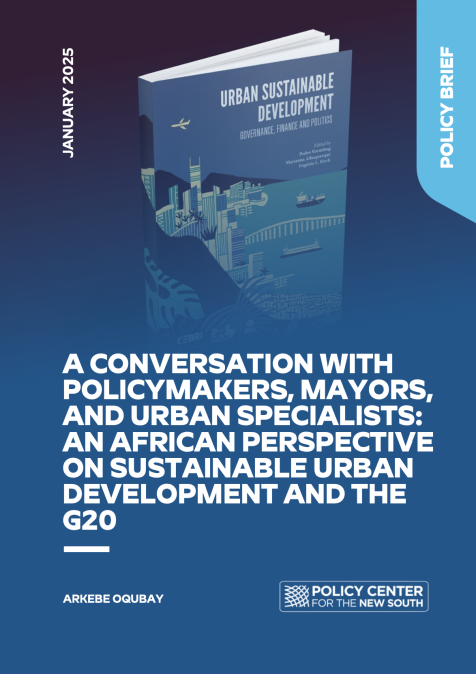
A Conversation with Policymakers, Mayors, and Urban Specialists: An African Perspective on Sustainable Urban Development and the G20
Authors
Arkebe Oqubay
January 20, 2025

This paper, included in the report "Urban Sustainable Development: Governance, Finance and Politics.", was originally published on:https://cebri.org/en/doc/356/cebri-and-rio-g20-committee-publish-urban-sustainable-development-governance-finance-and-politics

 © Vormittag, Pedro, Marianna Albuquerque & Eugénie Birch (Eds.). 2024. Urban Sustainable Development: Governance, Finance and Politics. Rio de Janeiro: CEBRI.


Sustainable urban development is vital for Africa, offering opportunities for a better future that requires political commitment and a collective response to global challenges. A shared perspective and productive debate on Africa’s challenges and future are essential to enhance economic transformation, urban sustainability, and the transition to a carbon-neutral economy. This commentary presents a compelling conversation among African policymakers, leaders, practitioners, and specialists on this pressing theme conducted in September 2024.

The conversation was based on a semi-structured qualitative survey featuring a qualitative format, targeted at a spectrum of African mayors, national policymakers, leaders of continental organizations, and development practitioners—urban specialists. The respondents play a critical role in shaping public policy and practice and include Prime Ministers and the African Union Commission Chairperson, offering a snapshot of their perspectives and concerns. Of the fifty invited participants, nearly 50% completed the survey, including eight ministers, seven officials of continental organizations, five development and urban experts, and the mayors of Rabat, Freetown, Windhoek, and Cape Town.

Cities are vital in attaining the United Nations 17 Sustainable Development Goals (SDGs) and the net-zero goals endorsed in 2015 under the Paris Agreement. The questionnaire comprised questions underpinned by cities’ contributions as innovation and economic growth engines, as well as Africa’s commitment to the common aspiration of the global community. African countries made a significant stride by unanimously adopting Agenda 2063, a 50-year road map with a theme of “Africa We Want,” which places sustainable urban development at its core. Most recently, in September 2024, the African Union Commission successfully organized an African Urban Forum in Addis Ababa. This pivotal forum delved into African urbanization and the challenges of financing to achieve sustainable and resilient urban development.

RELATED CONTENT

  • Authors
    Ahmed Ouhnini
    December 5, 2025
    “Uberization,” a term derived from the American company Uber in the early 2010s, initially refers to an economic model based on directly matching supply and demand through digital platforms. Rapidly popularized, the concept has expanded with Airbnb in accommodation, and then to a wide range of other sectors: food delivery, home services, e-commerce, and even traditionally regulated or corporatist professions. This neologism thus reflects a transformation of economic and social relat ...
  • Authors
    December 3, 2025
     Global GDP growth has proven resilient in 2025, despite the shocks caused by the trade policies implemented by United States President Donald Trump in the first year after his return to office. The gloomy projections offered by multilateral and private institutions in the first quarter of 2025 have given way to revised levels mostly in the 2.5% to 3% range for the year. ...
  • December 2, 2025
    في هذه الحلقة، نحاول اكتشاف ما الذي يجعل المغرب يعيش اليوم تحولاً لافتاً في عالم المدفوعات الرقمية. كيف أصبحت التكنولوجيا المالية أحد مفاتيح الشمول المالي ومحركاً لنمو جديد؟ وكيف يغيّر الاعتماد المتزايد لوسائل الدفع الحديثة حياة التجار الصغار والمقاولات الصغيرة والمتوسطة ويخلق لهم فرصاً...
  • Authors
    December 2, 2025
    This paper assesses the economic and environmental implications of Morocco’s strategic transition from internal combustion engine vehicle (ICEV) manufacturing to electric vehicle (EV) production, with a particular focus on the regional impacts of localizing high-value battery manufacturing. Using an interregional input-output model, extended with environmental satellite accounts, the study simulates a structural shock related to the wholesale substitution of ICEV-specific inputs wit ...
  • Authors
    November 28, 2025
    The adoption of United Nations Security Council Resolution 2803 on November 17, 2025, endorsing the “Comprehensive Plan to End the Gaza Conflict,” is a step in the right direction, but it must be accompanied by the implementation of a Gaza development and post-conflict reconstruction program. Paragraph 6 of Resolution 2803 “calls upon the World Bank and other financial institutions to facilitate and provide financial resources to support the reconstruction and development of Ga ...
  • November 27, 2025
    Digital payments are transforming global commerce and unlocking new opportunities for Morocco’s digital economy. But as innovation accelerates, so do security challenges and sophisticated fraud risks. In this episode, we explore how trust and protection must evolve to keep pace with a f...
  • November 25, 2025
    This Policy Paper analyses the Fourth Industrial Revolution (4IR) through the critical lens of technological colonialism. It argues that the fusion of physical, digital, and biological technologies is not merely a technical phenomenon but a civilizational shift reshaping the foundations of global power. The article traces a historical continuum from previous industrial revolutions, demonstrating how patterns of inequality and extraction persist, now transposed into the digital realm ...
  • Authors
    November 21, 2025
    This report addresses the business environment in Brazil as one of the determinants responsible for the weak evolution of productivity in recent decades. After addressing this productivity performance, we define what constitutes the business environment, using as a reference the three ways in which the World Bank has been addressing the subject.Next, we highlight how the business environment affects productivity in a country. Finally, we review some recent reforms in the country's b ...
  • Authors
    Lahcen Oulhaj
    November 19, 2025
    La modélisation classique de la croissance repose sur des outils – notamment la fonction de production agrégée et la comptabilité de la croissance – dont les incohérences logiques et les ambiguïtés épistémologiques sont connues depuis la Controverse de Cambridge et les travaux d’Anwar Shaikh. Pourtant, ces failles continuent d’alimenter des raisonnements fallacieux dans le débat économique et les discours institutionnels. Cet article montre que la nature tautologique de ces outils n ...