Publications /
Policy Brief

Back
African Union stance on the Sahara issue: incipient change
March 20, 2019

Morocco’s return to its “institutional family" by joining the African Union (AU) two years ago heralds renewed hope for positive progress in terms of the Organization's stance on the Sahara issue. This comeback, however, also raises fears and apprehensions over possible complications due to an intrusion by the continental organization into an exclusively UN process, geared since 2000 towards seeking a realistic and mutually acceptable political resolution.

RELATED CONTENT

  • Authors
    Ahmed Rachid El-Khattabi
    Alessandro Minuto-Rizzo
    Amaye Sy
    Hamza Rkha Chaham
    Ian O. Lesser
    Jorge Castañeda
    Moubarack Lo
    Umberto Profazio
    December 14, 2022
    This ninth edition of “Atlantic Currents” appears in an international context marked predominantly by a ten month-war between Russia and Nato members that began February 2022. The war is affecting not only the European and American member States directly and actively involved in an unprecedented manner, but more importantly the countries of the global South that have suffered collateral damage. Indeed, the nations of the world were barely out of the most painful and costly phase o ...
  • Authors
    Amr Abdelrahim
    December 9, 2022
    Depuis quelques années, l’activisme accru de la politique étrangère égyptienne – dans son voisinage africain, méditerranéen et moyen- oriental – donne l’impression du retour d’une puissance régionale dont l’influence s’est pourtant essoufflée à la fin des années 1960. L’avènement du président Abdel Fattah Al-Sissi marque une rupture avec la « diplomatie réactive » de l’ère Moubarak. Cependant, le pays ne dispose simplement plus de ressources militaires, économiques et ...
  • Authors
    December 9, 2022
    The global wave of democratic retrenchment has not spared North Africa as seen in the cases of Tunisia and Sudan, where democratic transitions have stalled or regressed into autocracy. How do to explain Tunisia and Sudan’s troubled transitions from authoritarian rule? Both states are attempting to transition from single-party authoritarianism. In both cases, economic crises exacerbated by COVID, the Russian-Ukraine war, and involvement by external actors stymied the fragile transiti ...
  • November 24, 2022
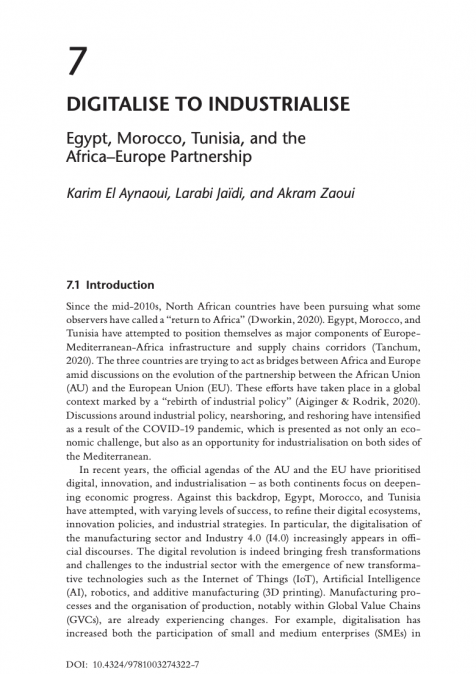
    This chapter was originally published in the book "Africa–Europe Cooperation and Digital Transformation", co-edited by Chux Daniels, Benedikt Erfoth, and Chloe Teevan Since the mid-2010s, North African countries have been pursuing what some observers have called a “return to Africa” (Dworkin, 2020). Egypt, Morocco, and Tunisia have attempted to position themselves as major components of Europe- Mediterranean-Africa infrastructure and supply chains corridors (Tanchum, 2020). The thr ...
  • Authors
    Sous la direction de
    November 1, 2022
    Dans cette nouvelle édition du Rapport annuel sur la géopolitique de l’Afrique, et à l’instar des éditions précédentes, le maître-mot est la richesse dans la diversité. Une diversité dans les visions et les opinions que des auteurs africains, habitués de cette tribune où qui la découvrent, alimentent en exprimant leurs réflexions sur des questions clés qui intéressent leur continent : l’Afrique. Du cadre social, à celui militaire en passant par les contextes historiques, anthropolo ...
  • Authors
    October 26, 2022
    La Communauté économique des États d’Afrique centrale (CEEAC) a entamé, à partir de 2015, un important processus de réforme institutionnelle. Décidée à l’issue de la XVIème Conférence des chefs d’État et de gouvernement de le CEEAC, tenue à N’Djamena, au Tchad, cette réforme constitue un tournant majeur dans l’histoire de l’organisation et une affirmation de sa centralité dans le processus d’intégration régionale en Afrique centrale. Ce Policy Brief vise à présenter les principaux r ...
  • Authors
    October 21, 2022
    This Policy Brief addresses the question of Europe's interest in the Nigeria-Morocco Gas Pipeline project. The paper advances six arguments to support this interest and its relevance. 1) The project effectively diversifies European gas resources and provide greater scope for action. 2) Building the pipeline helps create a new generation of measures to curb the asymmetric risks Europe faces. 3) The project mitigates the risk of replacing European dependence on Russian gas with anothe ...